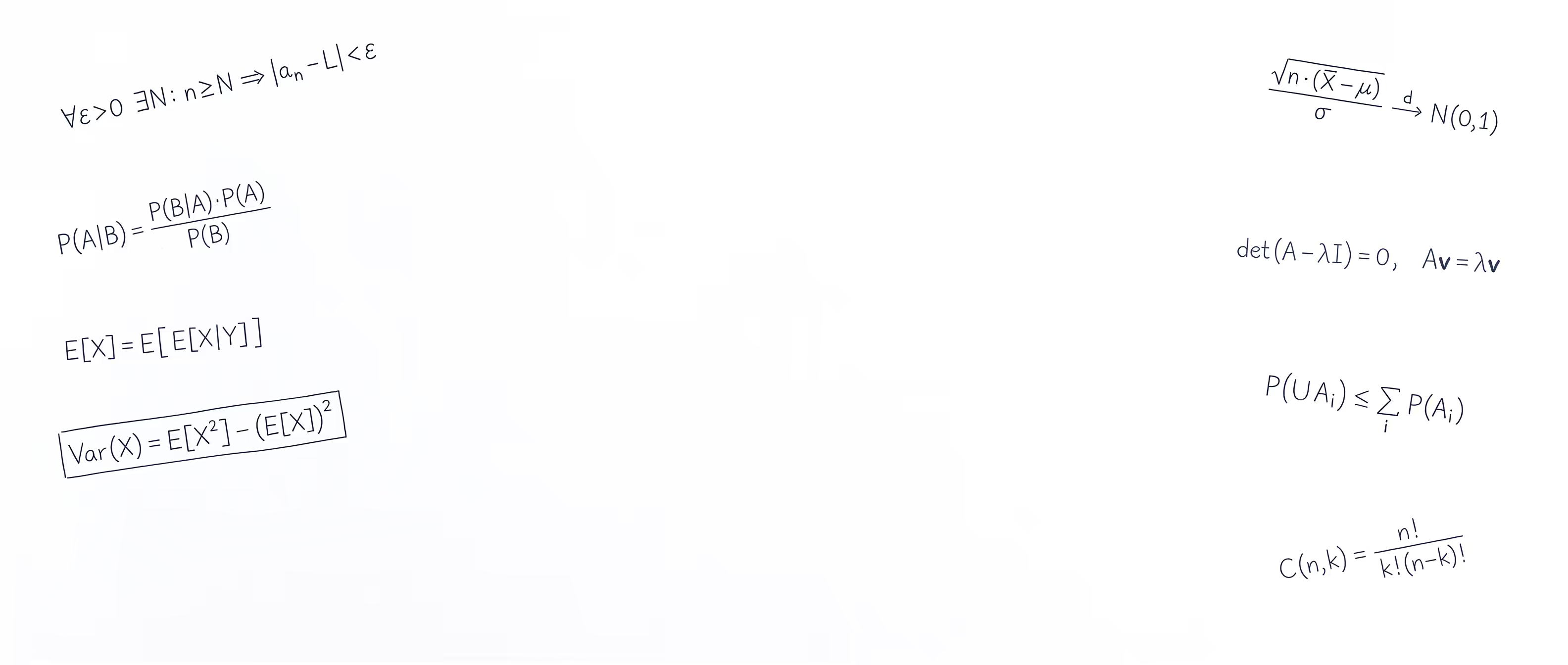
The ML depth round has no LeetCode.
Practise the follow-up questions of an AI/ML technical round in a timed mock, speaking or typing. Review the gaps in your answers and get a plan for what to practise next.
1 free completed mock · No card required
Defend it out loud.
Answer in your own voice. The examiner listens, asks the follow-up, and grades the transcript against the same fixed criteria as a text mock. Prefer typing? Text mode stays.
Speak your answer; the follow-up arrives as you finish.
The same examiner, the same criteria, the same report.
Switch to text whenever you cannot talk aloud.
Voice mocks are on the Voice plan, $69 a month. Your free mock runs in text.
How voice mocks workExaminer listening · voice mock
Your next interview starts with what you practise now.
Interview coming up? Find weak spots while there is still time to work on them. Start with a mock for your AI or ML role.
Last interview went badly? Practise the follow-ups that exposed a gap. Choose what to work on next, even without a new interview date.
Practise. Review. Try again.
Start with a mock for your AI or ML role. Use the feedback to focus your practice, then test your reasoning again.
Answer technical questions under a time limit, speaking or typing. The examiner follows up on the reasoning in your answers.
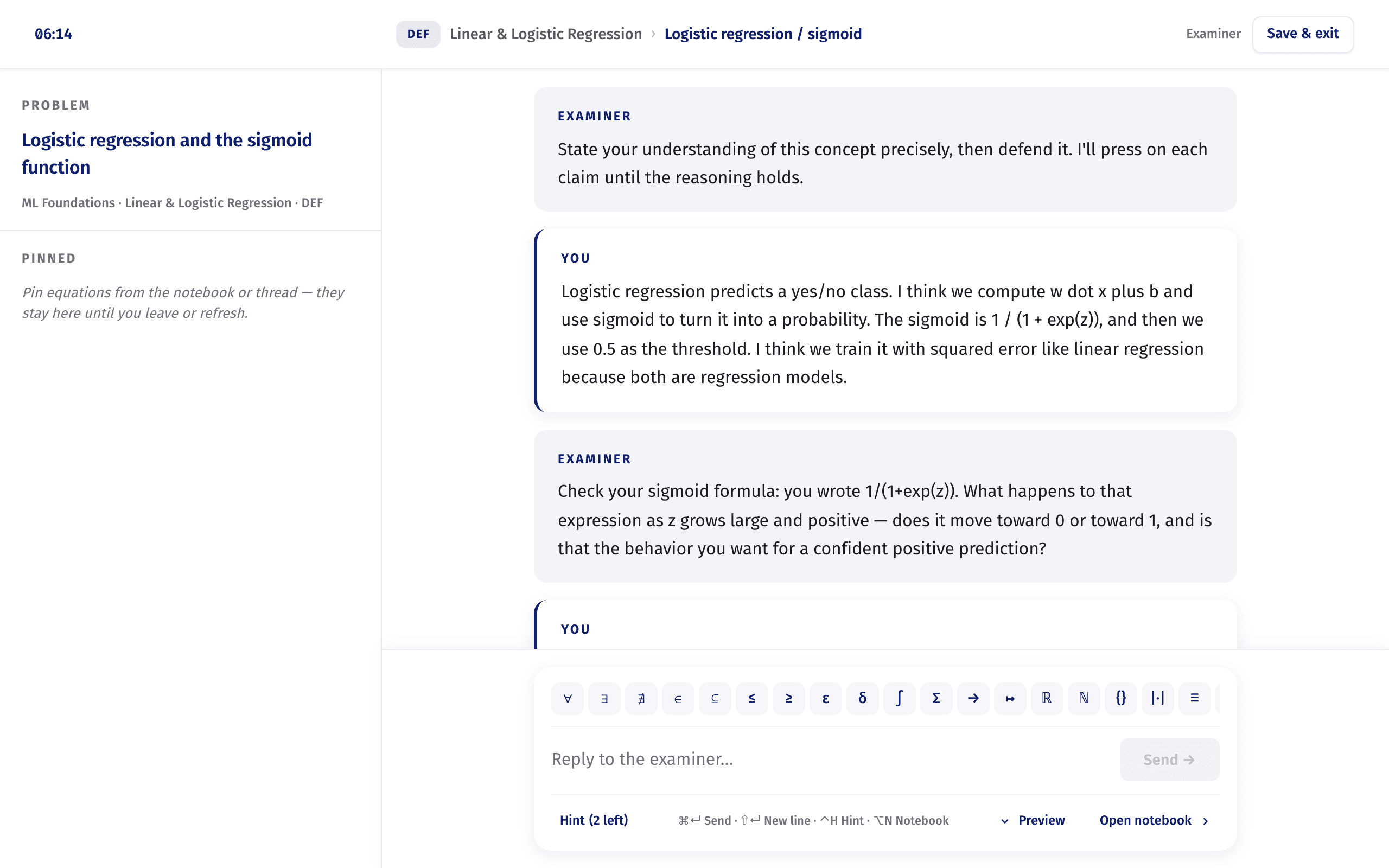
Illustrative exchange · model evaluation
See observed gaps ranked by priority, with evidence from your answers and targeted drills to work on them.
Follow-up mocks prioritise weak topics with fresh reviewed problems where available. Untested topics stay marked as untested.
Illustrative practice plan · individual drills require a paid plan.
1 free completed mock · no card
Know why a gap made the list.
See what broke down in a real mock, the topic it affected, and what to practise next. Open each question’s debrief for the evidence behind the finding.
Read an illustrative sample report to follow an answer through to its next practice step.
Your first completed mock, feedback and repair plan are free. Further mocks and individual practice drills require a paid plan.
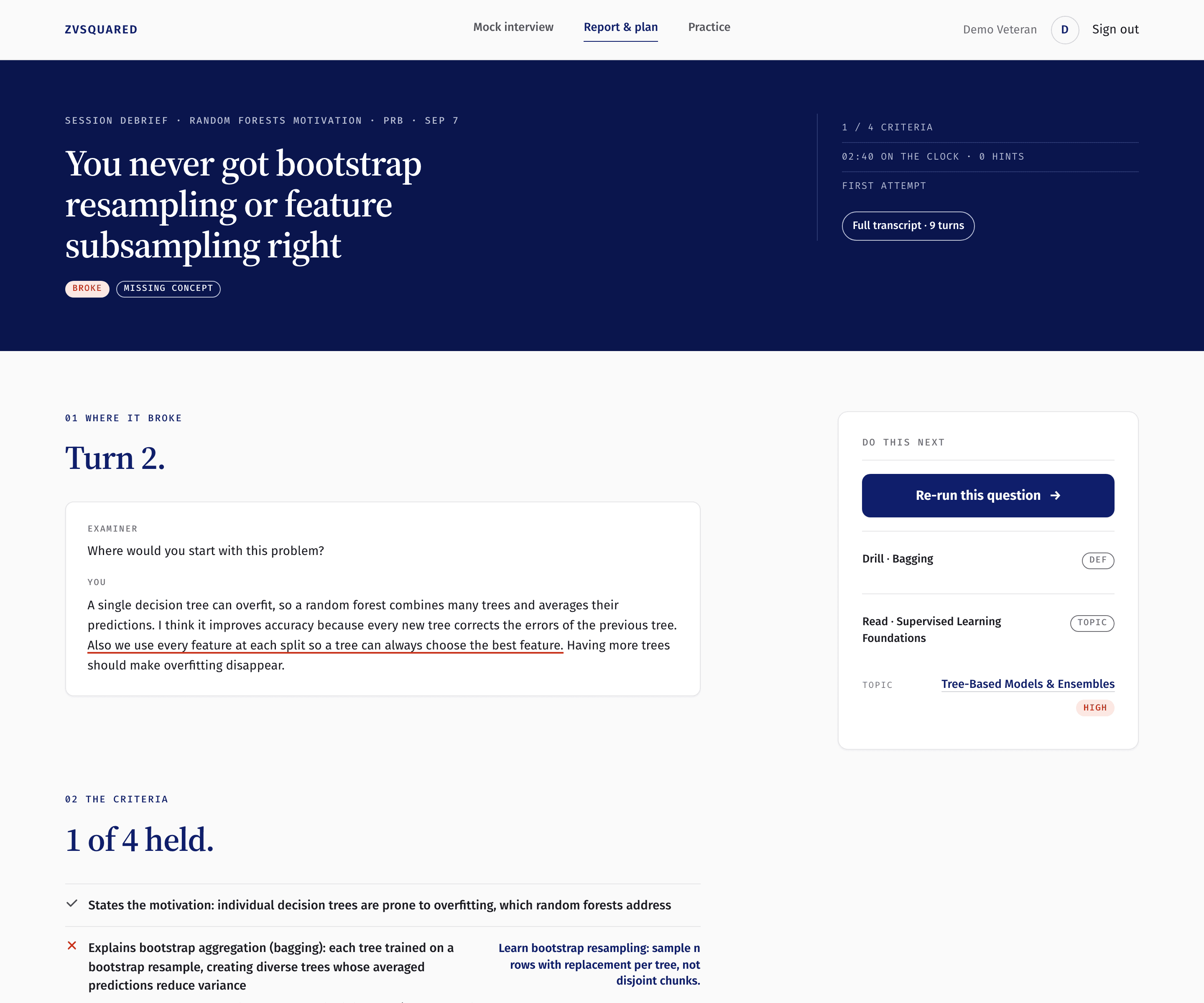
Demo account · real ML Engineer mock · imperfect answers · Move your cursor to inspect · tap on mobile
Reviewed before any mock. They cannot change mid-interview.
Feedback points to evidence from your recorded answers.
When the evidence is too thin, the report says so. Untested topics stay visible.
Timed. No hints. No restart.
Two to four questions per sitting, your choice.
The limit adjusts to seniority and question count.
The examiner stays in interview mode until the debrief.
Answer out loud or in text; the follow-ups come either way.
“Why the log?”
A third-round interview. Four months of preparation. He asked me to explain logistic regression, and I relaxed: finally, something familiar.
Then he cut in. My brain froze. Not because I had never used it. I knew it well enough to pass interviews, not deeply enough to defend it. I sat there in silence, and I knew the interview was over.
Most people practice polished answers. Great interviewers look for the cracks underneath them. I built the thing I wish I had back then.
Aleksandr Zvonarev · Founder
Practice for AI and ML technical rounds.
Focus on the concepts and decisions you may need to explain. Question selection follows your role and seniority; each mock covers a sample of topics.
Technical reasoning practice by voice or text. Prepare separately for coding, whiteboarding and behavioral rounds; this is not a complete interview-loop simulation.
Two ways to sit the mock.
Start with one free text mock and its report. Paid plans add unlimited mocks and drills; Voice adds a spoken examiner with live captions.
$39 billed monthly
Unlimited written mocks and drills, graded on your reasoning.
- Unlimited timed mocks and practice sessions
- Feedback tied to your answers
- Targeted drills and progress tracking
- Cancel anytime
$69 billed monthly
Everything in Text, plus spoken mocks with an examiner that talks back.
- Everything in Text
- Speak your answers; the examiner speaks back
- Live captions; switch to text at any time
- Cancel anytime
$129 billed every 3 months
The Voice plan for a whole cycle: diagnose, repair, retest.
- Everything in Voice
- Three months of unlimited mocks and drills
- Renews every three months; cancel renewal anytime
- Feedback tied to your answers
Prices in USD. Cancel anytime; 7-day refund on paid plans. Your report and repair plan stay available on the free tier.
Asked before buying.
Short answers. The FAQ inside the product goes deeper.
Who is this for?
AI and ML engineers with an interview coming up, or a recent interview they want to learn from. It is designed for practising technical reasoning and follow-up questions, rather than learning AI or ML from scratch.
Can I use it after a rejection?
Yes. You can start a fresh mock without a new interview date. The feedback identifies gaps in that practice attempt; it cannot tell you why an employer rejected you.
What do I get after a mock?
Feedback tied to your recorded answers, observed gaps ranked by priority, and a repair plan with targeted drills. Untested topics and inconclusive findings stay separate. There is no promised number of gaps or prediction of whether you will pass an interview.
What topics and formats are covered?
ML foundations and evaluation, AI engineering including LLMs and RAG, production reasoning, and relevant probability, statistics and linear algebra. Mocks are timed technical conversations, spoken or typed; the examiner grades the transcript either way. Coding, whiteboarding and behavioral rounds need separate preparation.
Voice or text: which should I use?
Both run the same mock and are graded the same way, on the reasoning in your transcript. Text: you write, with equations and a notebook. Voice: you speak, the examiner speaks back, live captions show what it heard, and you can switch to text at any point; your microphone stays off until you start it. The free mock is text. Choose Voice if your interviews are spoken and you want to practise thinking out loud under a clock.
Why is Voice $69?
One human mock interview on interviewing.io starts at $179 (their FAQ, September 2026). A month of unlimited spoken mocks here is $69, cancellable any time, with a 7-day refund. Your first text mock is free, so you see the grading before you pay.
How long does a mock take?
Choose two to four questions. The time budget depends on your seniority and question count, and is shown before you start. Mocks run with a timer and no hints or pauses.
Does it match a specific company's interview?
Questions are selected for your role and seniority. Company context does not select an employer-specific question set, and feedback does not reproduce an employer's hiring rubric.
Do I need a card for the free mock?
No. Your first completed mock interview is free and runs in text. Starting or abandoning a mock does not use one. After that, a paid plan is required to start another mock; your diagnosis, repair plan and completed debriefs remain available.
Are the practice drills free too?
The free tier includes one completed text mock and access to its feedback and repair plan. Individual practice drills and the full catalog require a paid plan; spoken mocks are on the Voice plan. You can also study the feedback independently before your next interview.
How does it fit alongside other preparation?
Use books and courses to study concepts, coding tools for implementation practice, and human mocks for interpersonal feedback. Zvsquared adds repeatable technical practice with follow-up questions, recorded evidence and targeted next steps. Fresh problems for a retest depend on the reviewed pool available for the topic.
Make your next practice session count.
Start a free AI/ML mock. Find what needs work and leave with a next step.
No card required · Your report stays available